
Sales
The Phased Outbound Growth Model: Why Brand Equity Comes Before the Cold Call
- By
- Daniel de Vries
- Published
On this page
At a glance
- Start with available opportunities and relationships.
- Content and engagement can inform account priorities.
- The phased model includes groundwork before multichannel outreach.
Work the existing database
Refresh contacts and relevant connections.
Publish and capture interest
Review personal content and engagement signals.
Sequence text before calls
Let email and LinkedIn context inform calls.
Qualitative workflow diagram: Work the existing database: Refresh contacts and relevant connections.. Publish and capture interest: Review personal content and engagement signals.. Sequence text before calls: Let email and LinkedIn context inform calls.
Why high-performing teams build brand equity and capture intent before they cold call, and the three-phase model that turns a small team into a pipeline engine.
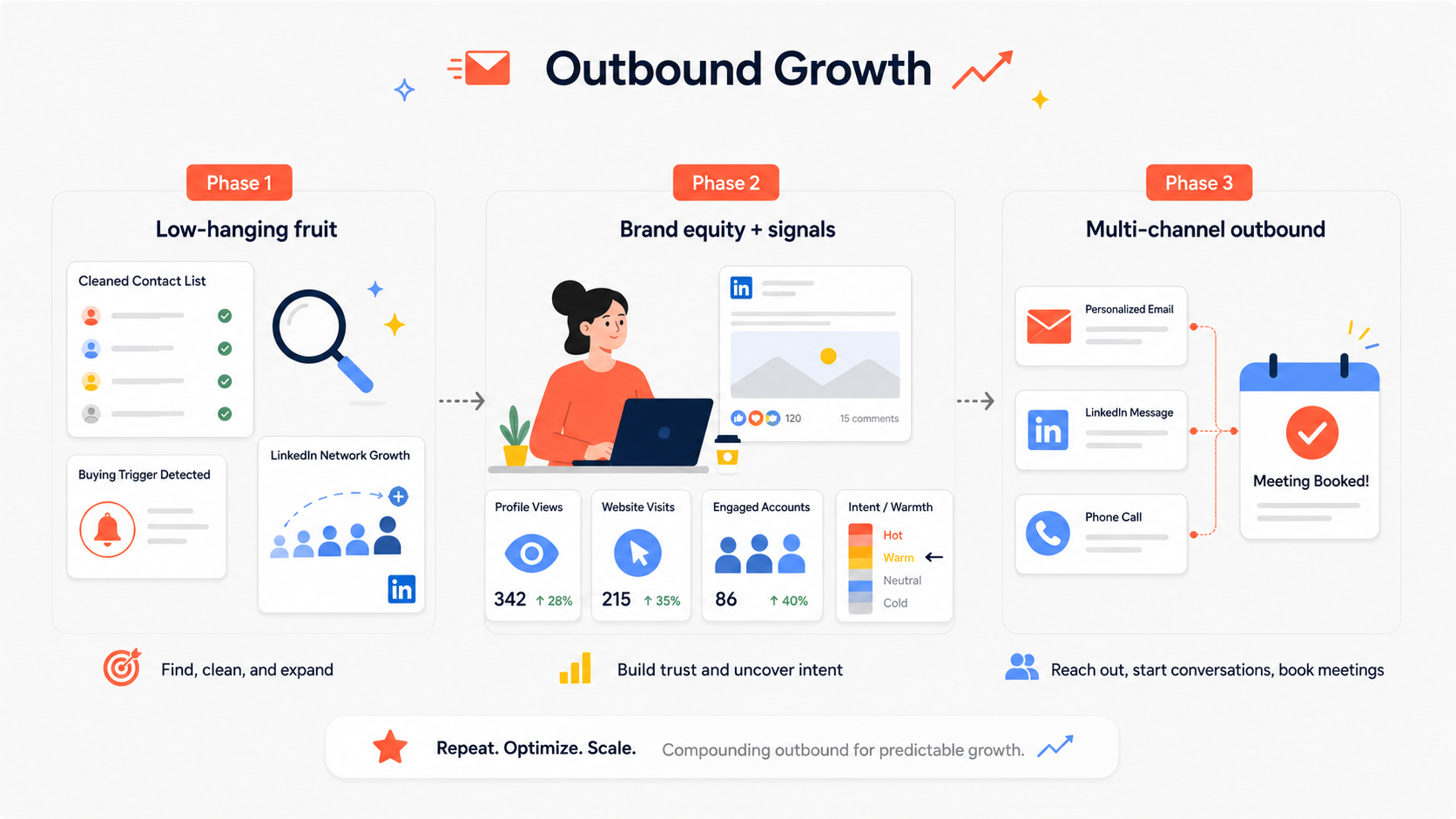
The instinct, when pipeline is thin, is to do more outbound immediately. More emails. More calls. More volume, starting today.
For a small commercial team, that instinct backfires. Outreach from an unknown sender, with no warm-up and no recognition, lands at the bottom of the inbox and the bottom of the priority list. Effort goes up. Results do not.
High-performing teams treat outbound as something they build toward in stages, not a switch they flip. The model has three phases, and cold calling sits in the last one.
Phase One: The Low-Hanging Fruit
The fastest pipeline is usually the pipeline a team already owns and has never worked properly.
Before any new activity, the first phase cleans and mines what exists. That means three things:
- Scrubbing the current contact list so every record still reflects the person’s real role.
- Hunting for immediate triggers inside that list, the accounts with a fresh reason to talk this month.
- Running steady connection campaigns from the team’s own LinkedIn profiles to widen the network inside the exact target profile.
None of this requires new tools or new headcount. It surfaces opportunities that were already sitting in the database, unworked.
Phase one is not glamorous. It is the cheapest pipeline a team will ever find.
Phase Two: Brand Equity and Signal Capture
The second phase makes the eventual outreach land, by making the sender familiar first.
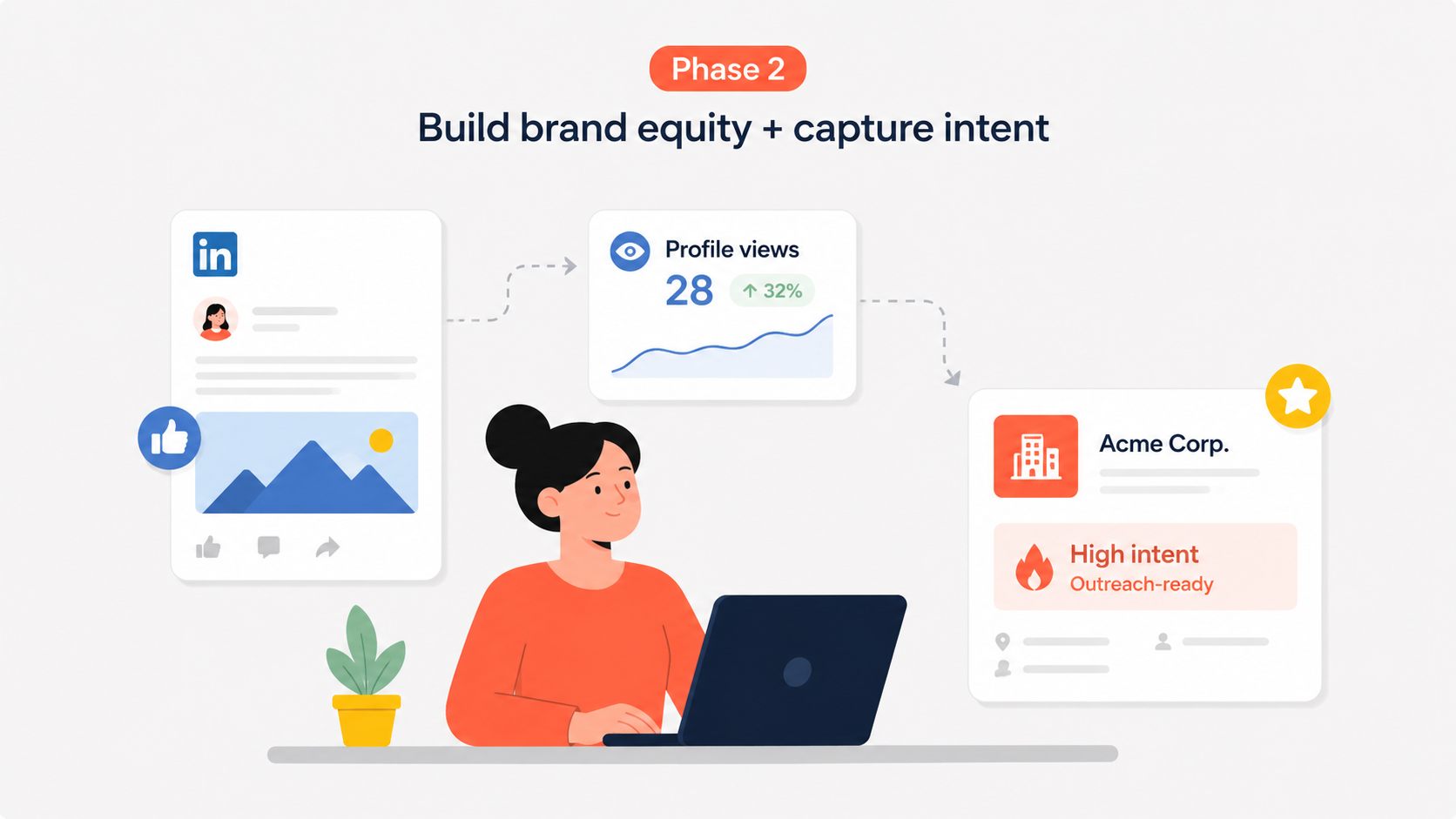
It starts with content, published from personal profiles rather than the company page. The reason is mechanical: native personal posts reach far more of the right people than brand-account posts. A commercial leader sharing a real perspective on the buyer’s problem builds more recognition than any company page can.
By the end of Phase Two, outreach is no longer aimed at strangers. It is aimed at companies that have already shown active interest.
Alongside the content comes signal capture. Intent tracking on the website and on the team’s LinkedIn profiles reveals which companies are quietly paying attention. That visibility reorders everything. A flat list becomes a ranked one, with the warmest accounts at the top.
Phase Three: Multi-Channel Outbound
Only in the third phase does the full outbound engine switch on.
It runs in a deliberate order: text-based outreach first, across email and LinkedIn. Then a phone follow-up, fed by everything the earlier phases produced, the intent signals, the new connections, and anyone who engaged with the text sequence.
The calls work because they are not cold. The person on the other end has seen the content, or visited the site, or accepted the connection. The phone is where warm interest becomes a booked meeting, not where a stranger is ambushed. This is the payoff for the patience of phases one and two.
The Race-Team View
There is a simple way to picture the whole model. A sales team is a race team. The reps are the driver. They know the product, the market, and the customer, and no one can replace that.
But a driver with no car and no fuel goes nowhere. The car is the outbound infrastructure, the integrated system for email, LinkedIn, phone, and signals. The fuel is a steady supply of verified, ready-to-talk prospects. The phased model is really the process of building the car and filling the tank before asking the driver to push the pedal.
Skip the build, and the driver burns out doing everything at once. Build it first, and every lap gets faster.
A Trade Worth Making
This model is slower to the first meeting than picking up the phone on day one. That is its honest cost. It trades a few weeks of groundwork for a far higher hit rate and a program that compounds instead of exhausting the people running it.
For a small team without a sales army, that trade is almost always the right one. Brute force does not scale. A sequence does.
If outbound were mapped across these three phases, which phase is your team quietly skipping, and what is that costing the calls at the end?
Stop burning outbound effort on completely cold channels. Let’s install the infrastructure required to generate momentum early.