
Buying Signals: How to Find Companies Ready to Buy Before Your Competitors Do
- By
- Daniel de Vries
- Published
On this page
At a glance
- Fit and a current reason to engage are different.
- Signals vary by market and may sit outside databases.
- Signals are evidence, not proof a company will buy.
Establish the fit universe
Identify companies that could plausibly buy.
Find market-specific changes
Inspect hiring, filings, and operational evidence.
Act with current context
Pair fresh signals with specific outreach.
Qualitative funnel diagram: Establish the fit universe: Identify companies that could plausibly buy.. Find market-specific changes: Inspect hiring, filings, and operational evidence.. Act with current context: Pair fresh signals with specific outreach.
Learn how to layer buying triggers on top of your ICP list so your team reaches out the moment a company is ready, not weeks after the window has closed.
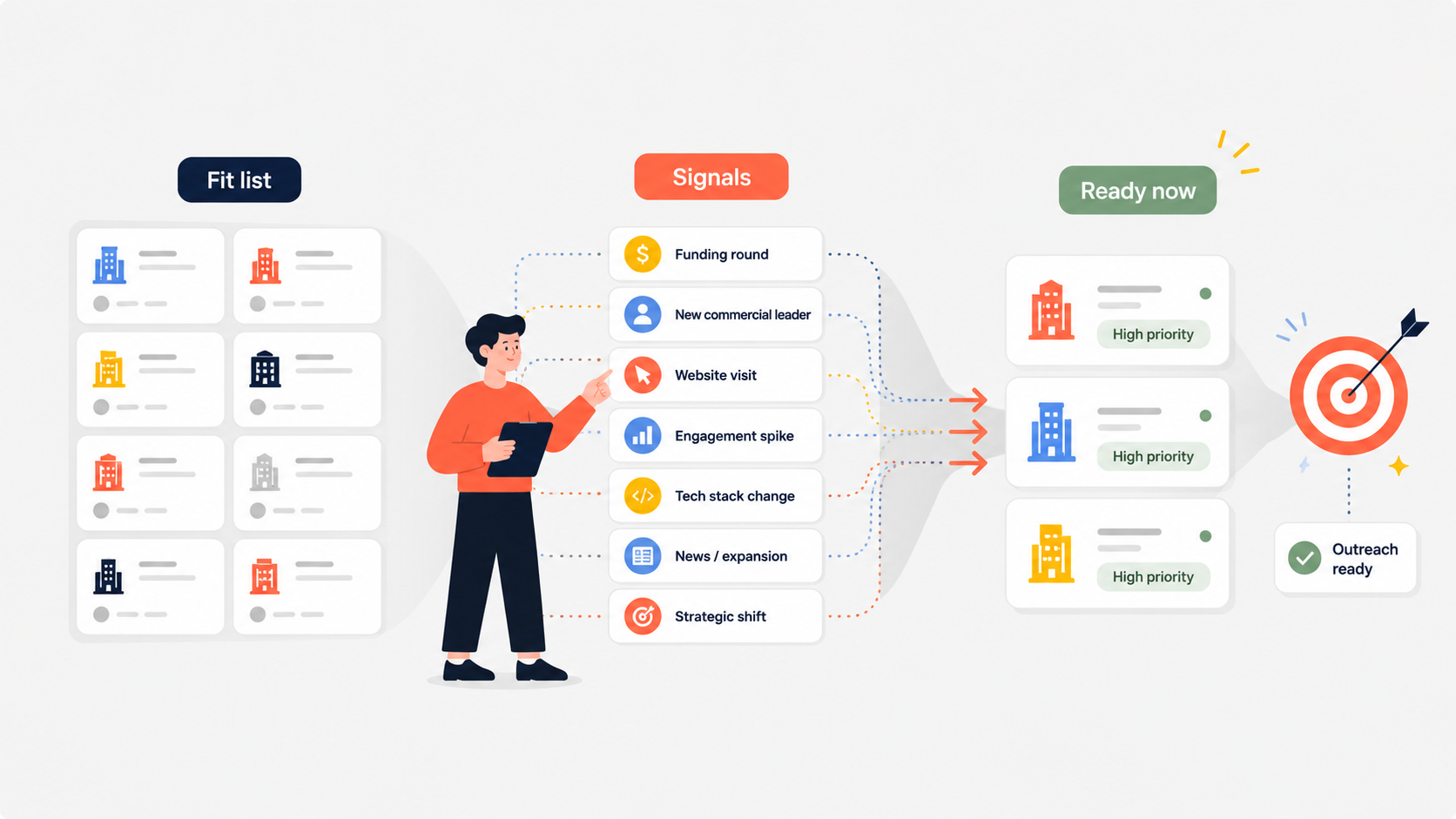
Most outbound starts from a list of companies that fit. Right industry, right size, right region. The list feels like progress. It is not.
A fit list answers one question: who could buy this, eventually. It is silent on the only question that drives a quarter: who is ready to buy now. That gap is where most outbound effort disappears.
The companies most likely to take a meeting this month are not the ones at the top of the alphabet. They are the ones where something just changed.
Why the Fit List Stops Working
For years, a clean filter in a standard database was enough. Pull every company in a sector, above a revenue line, in a region, and start dialing. The market was less crowded and buyers were more patient.
That era is over. Buyers are harder to reach, more skeptical of cold outreach, and protected by tools that punish high-volume sending. Working a 3,000-company list from top to bottom now means months of effort and real risk to sender reputation.
The fit list did not get worse. The cost of treating it as a target list did.
A trigger moves an account from theoretically relevant to currently in motion.
What a Buying Signal Actually Is
A buying signal, or trigger, is any event that suggests a company has a fresh reason to act. It moves an account from theoretically relevant to currently in motion.
Triggers fall into a few broad families:
- Firmographic events: Such as a merger, an acquisition, a funding round, or a new office.
- Hiring signals: Such as a new commercial leader, a sudden headcount surge, or a role left open for months.
- Strategic pivots: Such as a brand announcing a public shift toward science-backed products.
- Tech and operational changes: Such as adopting or dropping a tool, or mentioning a specific material or component.
- Engagement signals: Such as a company quietly viewing the website and a leadership profile in the same week.
The exact triggers that matter depend entirely on the market. For a fund-management software provider, fund launches and leadership changes signal intent. For a packaging supplier, a buried mention of a shipping material can reveal a switchable account. For a beauty-technology manufacturer, a public pivot toward clinical claims is the opening.
Different industries, one principle: something changed, and the change created a window.
Why Most of These Signals Are Invisible
Here is the uncomfortable part. The signals that predict buying best are usually the ones no standard database tracks.
A database will confirm a company exists. It will rarely reveal that the company just buried a relevant detail in its supplier terms, or filed a patent hinting at a new product line, or that a specific decision-maker viewed a profile yesterday.
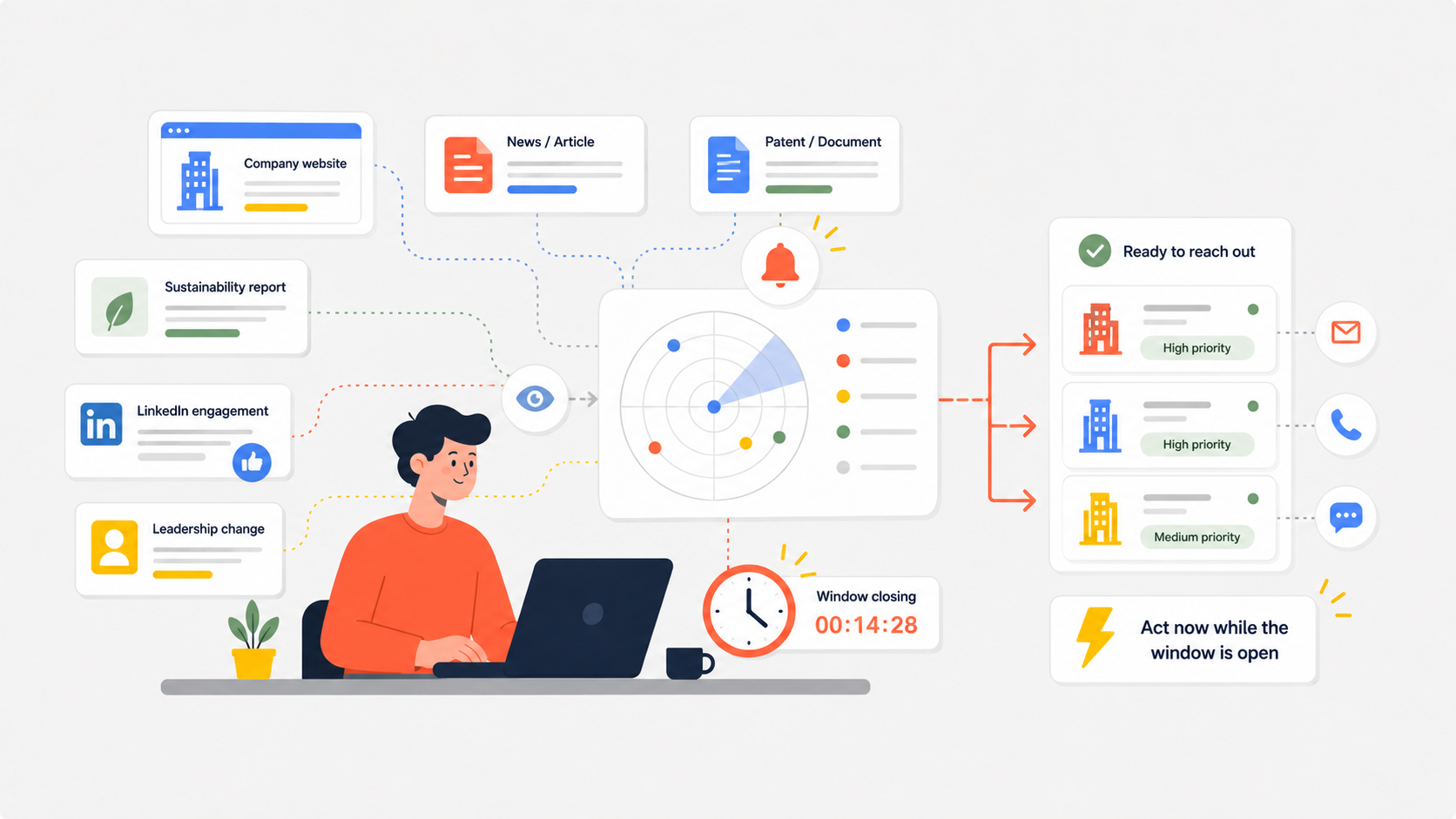
Finding those signals takes more than a filter. It takes crawling company websites for evidence, monitoring news, patent, and sustainability disclosures, and capturing engagement across the website and LinkedIn at the same time. The work is harder. That is exactly why so few competitors do it, and exactly where the advantage sits.
Timing Is the Whole Point
A signal has a shelf life. This is the rule most teams miss.
A trigger spotted today, paired with a contact who only gets called in six months, is worth nothing. By then the window has closed and the contact may have moved on. The value of a signal decays almost as fast as the data behind it.
This is why volume and signals pull in opposite directions. A giant list invites slow, batch-and-blast outreach. A signal demands a fast, specific response while the window is open.
The right model is small and quick, not large and patient.
Ready to Buy Now, Not Eventually
A fit list tells a team who their market is. A signal tells them who in that market is leaning forward today. The first is a foundation. The second is a pipeline.
The companies ready to buy are already showing it, in their hiring, their announcements, their filings, and their quiet visits. The teams that win are simply the ones paying attention while the window is still open.
Pipeline Analysis
Which signals in your market would tell you a company is ready to move, and how would your team know the moment one appears?
Stop burning out your SDRs on stagnant database exports. Let’s design an automated intent-layer structure tailored to your exact industry triggers.