
How to Sell Into a Niche Market When the Data Does Not Exist
Selling into a niche market is hard enough. It becomes exponentially harder when the two most important qualification criteria simply do not exist in any standard database.
That was the exact challenge facing a leading provider of AI-powered hotel software.
Their platform delivers exceptional results, but only for a very specific segment of the market: hotels with more than 100 rooms, and hotels running a compatible Property Management System.
On paper, this sounds straightforward. In practice, it was a prospecting nightmare.
Room count is rarely published in structured datasets. PMS information is often buried deep inside booking flows, page source code, or legal footers. Most of the time, it is not listed anywhere at all.
Manual research across thousands of hotel websites was not scalable. Guessing led to wasted outreach, low conversion rates, and frustrated sales teams.
So we engineered a custom extraction workflow.
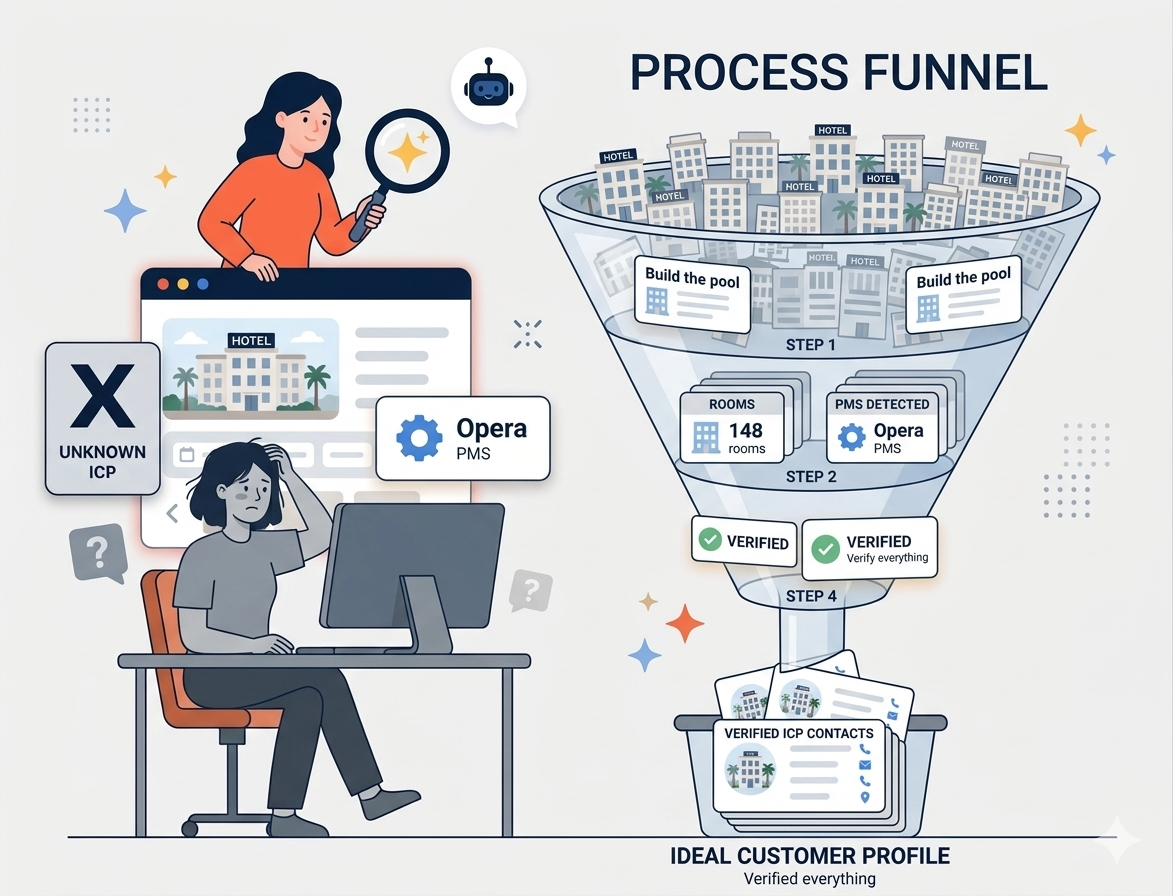
The Four-Step Framework
01
Build the prospect poolWe started by creating scale before precision, scraping hotel listings from major booking platforms to generate a large initial pool of potential prospects across regions, hotel types, and independent properties. |
02
Find the hidden dataWe built AI agents to crawl hotel websites and uncover data hidden in booking engines, reservation flows, website footers, legal pages, privacy policies, terms, and technical scripts. |
03
Verify everythingWe cross-verified PMS and technology stack signals using BuiltWith, filtering out false positives and reducing the risk of sales teams reaching out to incompatible hotels. |
04
Find the human behind the hotelOnce a hotel met the room count and PMS requirements, we used a broader verification stack to identify decision-makers, verify business emails, and enrich profiles with direct dials. |
The Stack Behind the Playbook
This project was not solved by one database. It required a layered workflow where each tool had a specific role.
What we used
- •Major booking platforms to build the initial hotel universe and avoid missing relevant independent properties.
- •Custom AI agents to crawl hotel websites, booking flows, technical scripts, privacy pages, and legal footers.
- •BuiltWith to cross-check PMS and technology stack signals before accounts entered the final list.
- •LinkedIn Sales Navigator to dynamically map commercial and operational stakeholders without relying on outdated static firmographics.
- •Clay to orchestrate enrichment workflows, combine sources, and structure the qualification process.
- •Prospeo, ZoomInfo, and Cognism to support decision-maker identification, bypass catch-all servers, verify business emails, and enrich profiles with direct dials.
- •A broader 15-tool verification stack to validate contacts before adding them to the final outbound list.
Step 1: Build the Prospect Pool
We started by creating scale before precision.
Instead of relying on incomplete databases, we scraped hotel listings from major booking platforms to generate a large initial pool of potential prospects. This gave us coverage across regions, hotel types, and independent properties that traditional data providers often miss.
At this stage, the goal was not perfect qualification. It was to ensure we were not missing the right hotels entirely.
Step 2: Find the Hidden Data
Next came the hardest part.
We built AI agents to crawl each hotel’s website with one specific objective: uncover the data no one else could reliably access.
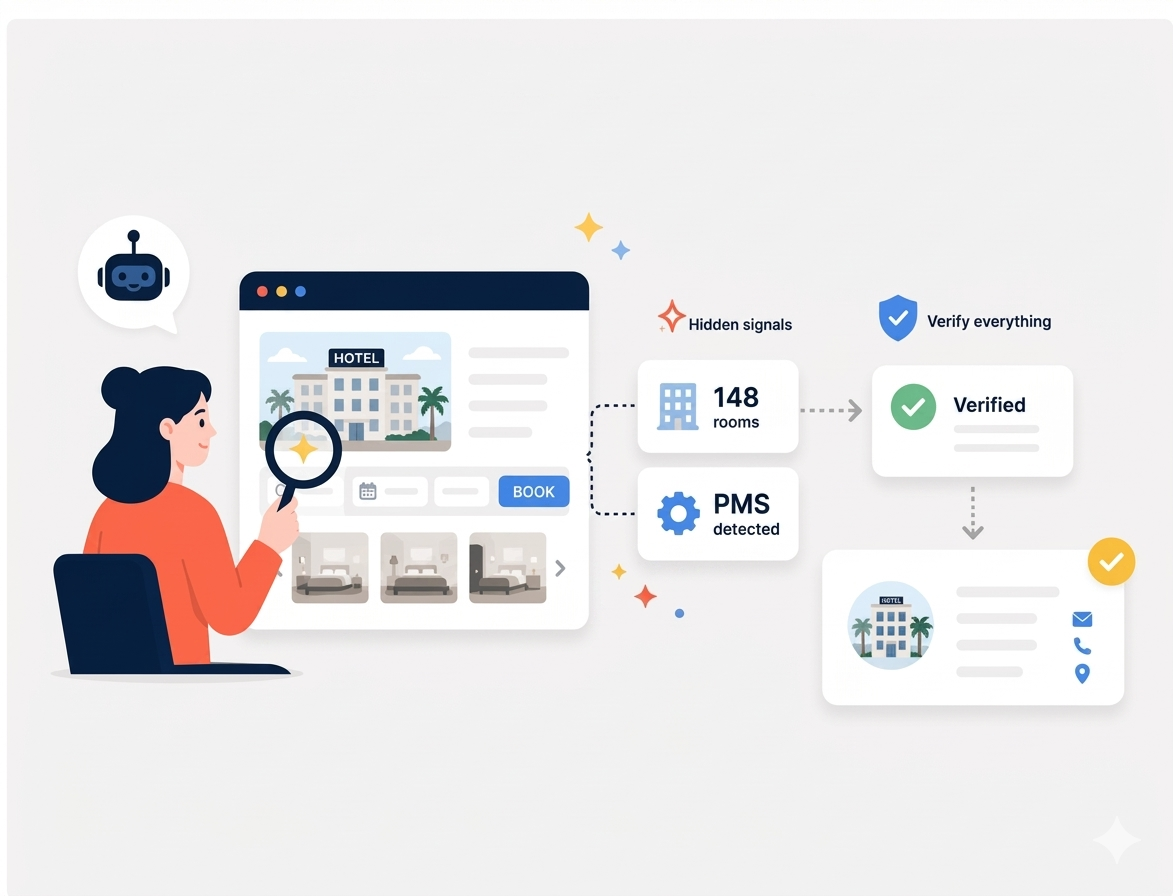
These agents explored booking engines and reservation flows, website footers and legal pages, and privacy policies, terms, and technical scripts.
From these locations, we extracted two critical data points: estimated room count and the PMS or booking engine in use.
This turned unstructured, hidden information into usable qualification data at scale.
Step 3: Verify Everything
Accuracy matters more than volume.
To ensure the data could actually be trusted, we cross-verified PMS and technology stack signals using BuiltWith. This validation step filtered out false positives and reduced the risk of sales teams reaching out to incompatible hotels.
By the end of this step, the list was no longer speculative. It was defensible.
Step 4: Find the Human Behind the Hotel
A qualified account is only valuable if you can reach the right person.
Once a hotel met the room count and PMS requirements, we focused on precision corporate mapping. Rather than relying on rigid database filters, we used LinkedIn Sales Navigator to target the current decision-makers actively handling operations and commercial strategy.
From there, we deployed a cascade of specialized tools. We integrated Prospeo to accurately unlock direct corporate emails and bypass tricky catch-all email domains, paired with ZoomInfo and Cognism to enrich the records with valid mobile numbers.
Each contact went through our 15-tool verification engine to ensure zero bounces before hitting the outbound sequence.
The Results
The outcome was a clean, actionable list of ideal customers that sales teams could trust.
| 73% of targeted hotels had a specific PMS or booking engine identified | 74% of decision-makers had verified business emails retrieved | 67% of those contacts had mobile numbers secured |
What started as a haystack problem became a highly qualified outbound engine.
Stop Prospecting Blind
Niche markets rarely fail because the product is weak. They fail because the data does not exist in the places most teams look.
When critical qualification data is hidden, you either accept inefficiency or you build systems designed to surface the truth.
This is how you stop prospecting blind.
What is the single hardest data point your team struggles to find?
If your ICP depends on data that standard providers cannot see, the answer is not more guessing. It is a custom data-building workflow.
Book a discovery call